
Arshin Register: Digital Traces of Western Equipment in Russia
Wait… You Could Do That?
Russia maintains the world’s largest public database of sanctioned western equipment. All you need to do is make the right queries — and interpret the answers correctly.
Summary
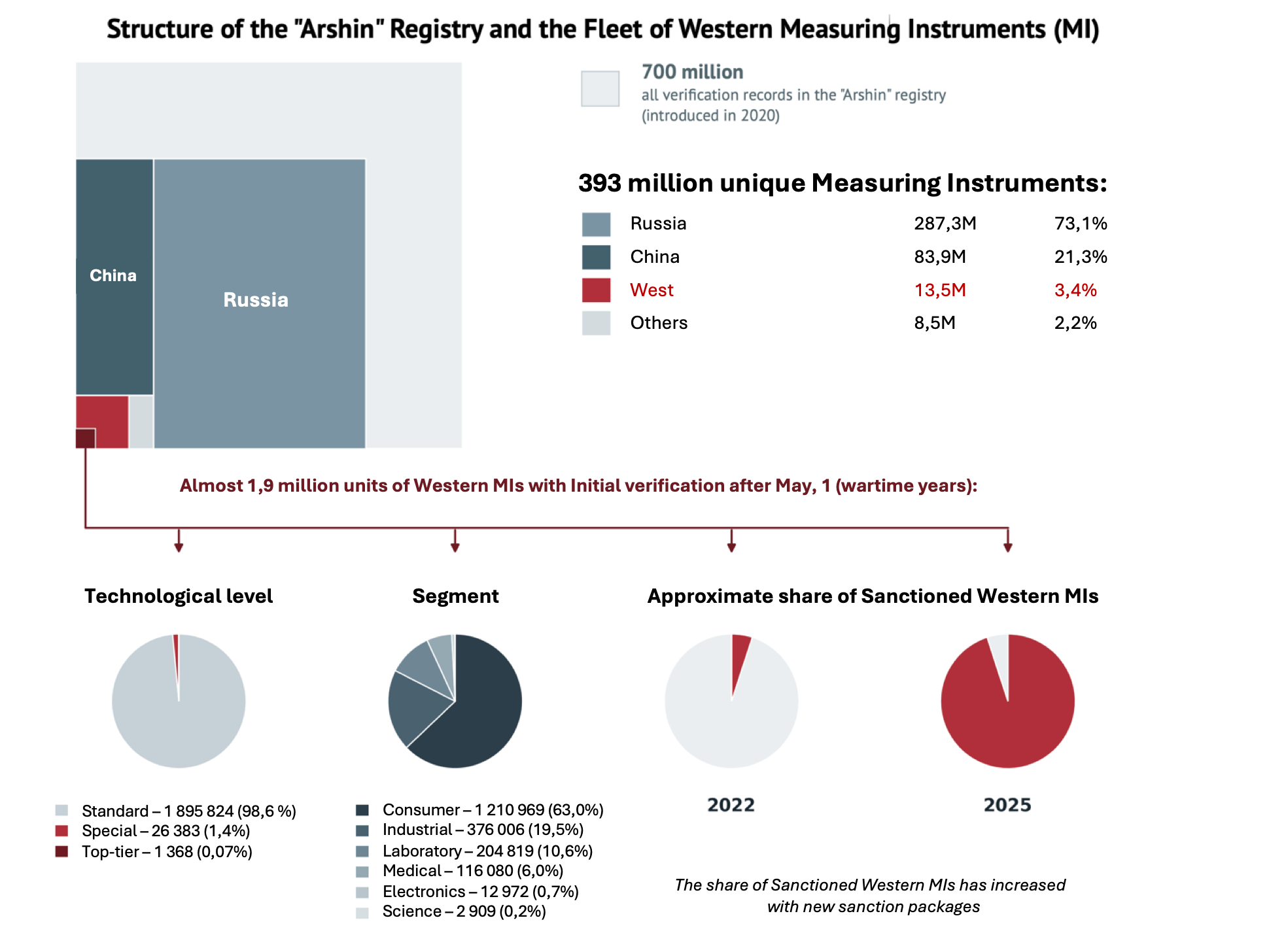
Russia’s public Arshin Register of Measuring Instruments (MIs) is a nationwide database of verification records for measuring instruments used within the country’s legal metrology system. Each record may include the manufacturer, model, owner, serial number, verification date, and verification type. The Initial Verification status is of particular importance. It indicates that a measuring instrument entered legal service in Russia for the first time. For researchers investigating sanctions circumvention, each such record serves as an official confirmation that a specific instrument was placed into operation in Russia. Since May 1, 2022, the register has recorded nearly 1.9 million initial verifications of Western-made measuring instruments. In 2022, only a small proportion of Western measuring instruments were covered by export restrictions. Today, the situation is almost the reverse: sanctions extend even to ordinary tape measures. The serial number recorded in a verification certificate is the key that transforms statistical data into actionable evidence. Instead of examining thousands of possible shipments, investigators can focus on a single physical instrument and reconstruct its legitimate supply chain. This reduces the scope of any audit by orders of magnitude while substantially strengthening the evidential basis for identifying potential sanctions violations. To facilitate such work, we have published a searchable database containing all initial verifications of Western measuring instruments recorded in Russia since May 2022.
Introduction. Research, Not an Investigation
This article is not an investigation. It is a study of Russia’s Arshin verification register and demonstrates how, using appropriate filtering and classification methods, it can be transformed into a comprehensive database of Western measuring instruments currently operating in Russia.
Since the register contains no meaningful internal classification of equipment, this study develops a practical methodology for categorising and segmenting the recorded instruments. This makes it possible not only to estimate the overall scale of Western equipment present in Russia, but also to analyse individual categories and examine how their composition has changed over time.
The article also explores one of the register’s most important practical applications: its use as a starting point for investigations into possible sanctions circumvention by government agencies, independent investigators, and equipment manufacturers themselves.
At the same time, the limitations of this approach should be recognised. The Arshin register does not reveal how a particular instrument reached Russia. It may have been delivered before sanctions were introduced, purchased on the secondary market, re-exported through a third country, transferred between organisations, or imported through another route. Determining the actual supply chain requires a separate investigation for each individual instrument.
Nevertheless, when the dataset contains hundreds of thousands of instruments as opposed to isolated examples, a broader question inevitably arises. If Western equipment continues to appear in Russia on such a scale, the focus must shift from individual shipments to the system itself. Why does this continue to happen? To what extent does this reality align with the objectives of Western sanctions? And, perhaps most importantly, what practical measures could make those sanctions significantly more effective?
Arshin: A Data Source Russia Keeps Open
Russia’s Federal Law On Ensuring the Uniformity of Measurements requires measuring instruments used in regulated applications to undergo regular verification confirming that they meet prescribed metrological requirements. The results of these verifications are published in the FGIS “Arshin” register — a free, publicly accessible online database. In practice, Arshin is a digital archive of Verification Certificates familiar to anyone who has dealt with water, electricity or gas meters in Russia or other post-Soviet countries. Each record typically contains the instrument type, manufacturer, model, serial number, verification date, verification type, owner, verification laboratory, and other technical information. Today, the register contains approximately 700 million verification records. These are not 700 million instruments. Because every instrument undergoes repeated verification during its service life, matching records by serial number reduces the database to roughly 393 million unique instruments. The relatively modest reduction reflects the fact that Arshin has existed only since late 2020, while most mass-produced measuring instruments are verified only once every several years.
The key to the analytical method presented in this paper is the distinction between the two verification types recorded in Arshin: “Initial Verification” and "Periodic Verification”. Every newly manufactured or newly imported measuring instrument — whether new or second-hand — must undergo Initial Verification before it can legally enter service in Russia. All subsequent verifications are classified as Periodic. (A minor exception existed until 1 March 2025, when instruments returning from major overhaul also underwent Initial Verification.) Consequently, the date of an Initial Verification serves as a reliable proxy for the instrument’s entry into the Russian market. For the purposes of this study, we assume that Western measuring instruments receiving Initial Verification after 1 May 2022 entered Russia after the first wave of sanctions imposed in response to the full-scale invasion of Ukraine. The preceding twelve months serve as the pre-war baseline. Why was 1 May 2022 chosen as the dividing line? By that time, the first export restrictions introduced after the invasion had begun to affect actual deliveries. Accordingly, the analysis uses five consecutive annual periods: 21* - pre-war baseline, 22*-25*— first, second, third, and fourth years of the war. This distinction forms the analytical foundation of the entire study.
Classification: Segment and Technological Level
The register contains over 9,000 types of Western measuring instruments. A traditional approach to classification based on principles of operation could have reduced this figure by one or two orders of magnitude; while methodologically sound, such an approach would have been prohibitively labor-intensive. Consequently, this task has been deferred to future research. Instead, the present study proposes a practical, two-dimensional classification framework. These dimensions effectively differentiate spectrum analyzers from spectrophotometers, as well as commercial scales used for retail weighing from high-precision comparison balances used for mass standards.
The first dimension is the functional segment (“Segment”) – what the instrument is primarily used for:
- Science – research equipment, including mass spectrometers, electron microscopes, and X-ray diffractometers.
- Electronics – radio-frequency and electronic test equipment, including oscilloscopes, signal generators, spectrum analysers, and frequency counters.
- Laboratory – routine analytical laboratory instruments such as spectrophotometers, pH meters, and balances.
- Industrial – production and field measurement equipment, including flow meters, flaw detectors, surveying instruments, and coordinate measuring machines.
- Medical – diagnostic and clinical measuring instruments.
- Consumer – everyday measuring devices such as utility meters, weighing scales, pressure gauges, blood pressure monitors, and tape measures.
The second dimension is the technological level (or level of replicability, “Level”). This is a subjective assessment of the extent to which a given device can be replaced by equivalents from Russia and China. We based our assessment on technical specifications and on verifying the existence of a functional Russian or Chinese equivalent; the boundaries are sometimes blurred, and another researcher might have drawn them slightly differently.
- Standard – there is a functional mass-produced Russian or Chinese equivalent (of lower quality, but it fulfils its function).
- Special – difficult to replace: equivalents are much inferior or few and far between; can be partially replaced with Chinese equipment. These may also be ‘Ordinary’ devices, but with a unique additional feature, for example, an explosion-proof design.
- Top-tier – no viable replacement: unique technology; there is no Russian or Chinese equivalent, or it falls short in terms of performance.
An interesting observation: a very rough estimate suggests that the total cost of equipment is comparable across all tiers: the small quantity is offset by the high unit cost.
Special and Top-tier equipment best demonstrates the West’s technological superiority. Its share is low (1.4 %). Preventing such equipment and spare parts from reaching the Russian Federation must be the focus of maximum effort by the sanctions authorities. Importantly, this principle extends far beyond measuring instruments alone.
Breakdown of essential equipment by segment over the four years of the war (22*–25*):
|
Segment |
Total |
Almost non-replaceable (Spec+Top) |
Spec+Top Share |
|
Science |
2 909 |
2 660 |
91% |
|
Electronics |
12 792 |
11 881 |
93% |
|
Laboratory |
204 819 |
3 268 |
1,6% |
|
Industrial |
376 006 |
9 601 |
2,6% |
|
Medical |
116 080 |
340 |
0,3% |
|
Consumer |
1 210 969 |
1 |
0,0% |
|
Total |
1 973 575 |
27 751 |
1,4% |
Almost all non-replaceable MIs are concentrated in two of the six segments — Science and Electronics — where nine out of ten instruments are Special or Top-tier; the remainder (laboratory, industrial, medical) are 97–99% standard. In absolute terms, the largest segments are Electronics (≈12,000) and Industrial MIs (≈9,600). In the latter case, only 2.6% are non-replaceable, but this segment is so large that it still accounts for a significant portion of the total figure.
Owners: when the Secret Department lapsed
The inclusion of the owner’s identity in the verification document is optional. In fact, approximately one-third of the verification records disclose the owner; this is often a distributor performing simultaneous verification for a batch of small MIs. In other words, this field cannot be used to precisely quantify the overall distribution of MIs across industries. Unsurprisingly, a wartime shift in the owner profile toward the military segment was anticipated. What was unexpected, however, is that the disclosed owners of Western equipment include institutions whose instruments, in principle, should never have appeared in a public registry:
- Nuclear Weapons – Dukhov Automatics Research Institute (VNIIA; nuclear warheads and detonation systems), Zababakhin All-Russian Scientific Research Institute of Technical Physics (VNIITF; thermonuclear warheads): oscilloscopes, radiation spectrometry, helium leak detectors.
- Missiles, Air Defense, Aviation – KBP Instrument Design Bureau ("Pantsir" and precision-guided weapons), UPKB "Detal" (altimeters for cruise missiles), Progress Rocket Space Centre ("Soyuz" launchers, satellites), Sukhoi (Su-35/Su-57), UKBP (avionics for Mi-28N/Ka-52): oscilloscopes, signal generators, spectrum analyzers.
- Radars, Communications, Electronic Warfare – Radar MMS, NII TP (space-based radar systems), NIIRS (signals intelligence), Radiosvyaz (military satellite communications), NPO Radar (test benches for air defense radars), Pluton (microwave components for radars), Polyus Research Institute (laser systems): signal generators, spectrum analyzers, frequency counters
Four-Year Wartime Dynamics
Over the four years of war, the volume of initial verifications has contracted by nearly two-thirds (dropping 63%, from 0.97 to 0.36 million per year). However, the reasons behind this decline require cautious interpretation (see also Section 7).
|
Equipment
Class |
21* |
22* |
23* |
24* |
25* |
Change |
|
Electron
microscopes |
22 |
10 |
25 |
14 |
16 |
−27% |
|
Mass
spectrometers (Top) |
29 |
15 |
17 |
8 |
15 |
−48% |
|
Coordinate
measuring machines (Top) |
137 |
69 |
95 |
110 |
78 |
−43% |
|
Electronics
(top) |
375 |
147 |
261 |
179 |
104 |
−72% |
|
Leak detectors |
74 |
30 |
38 |
27 |
17 |
−77% |
* - from May 1 to April 30 of the following year
The normalized charts showing the dynamics across different technological sophistication levels and individual instruments are of particular interest. We observe a sharp drop in non-replaceable types of MIs during the first year of the war (22*, nearly double the average rate), a rebound in 23*, followed by a gradual decline. It is worth noting that the initial sanctions directly targeted this equipment immediately after the outbreak of the war, and we clearly see this shock effect in the first year. What explains the rebound? New supply chains were likely established, compensating for the pent-up demand of 22*. Why is demand lower overall, and what drives the ongoing decline? Due to supply chain complications, prices rose, and the market reacted with a drop in demand. Furthermore, demand is falling due to the deteriorating macroeconomic climate. Since this equipment is of an investment nature, investments are always the first to suffer. The behavior of selected equipment types reveals an interesting pattern: while all of them experienced a shock-driven drop in the first year, their subsequent trajectories diverge – a phenomenon that warrants further research.
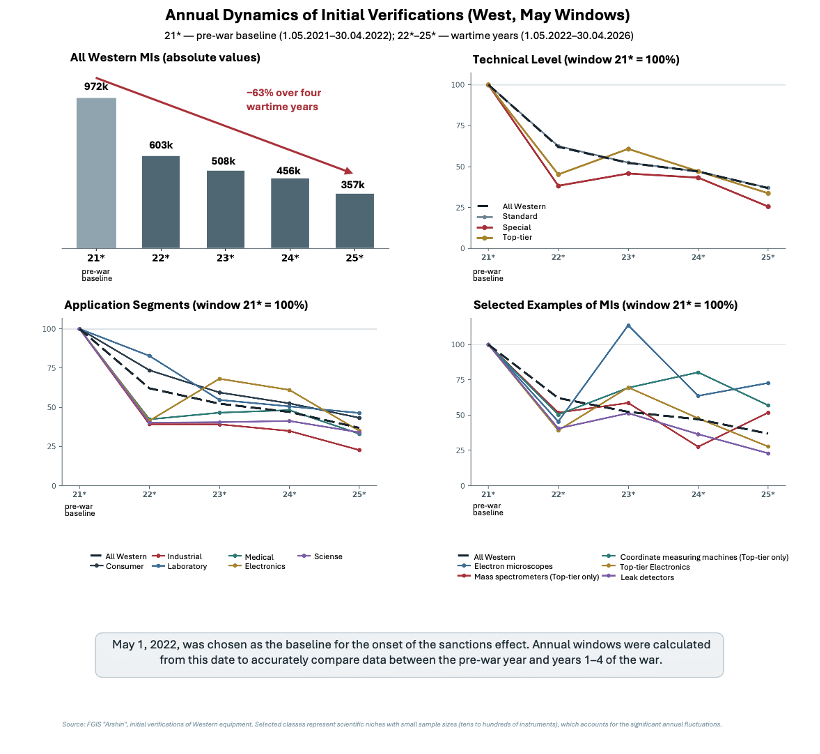
A compelling example is mass spectrometer leak detectors (leak testing instruments required in the nuclear industry, rocket engineering, and microelectronics). Before the beginning of the war, Russia developed its own domestic alternatives. Today, thanks to these Russian counterparts, the overall market entry rate in this segment is growing, despite the decline in Western equipment. This trend directly aligns with the concurrent rise in investments across the aforementioned sectors.
Serial Numbers: From Statistics to Investigation
Everything discussed previously constitutes macro-level analytics: it explains the state of affairs but does not, on its own, provide actionable results. An investigation begins with specific questions: which exact instrument, when, from whom, and to whom? While the registry does not provide a direct answer, it offers millions of serial numbers instead.
Why is this a complete game-changer? Knowing that 'an instrument of a specific brand and model exists in Russia' gives investigators almost nothing to work with: the manufacturer may have produced tens, hundreds, or thousands of such units, forcing teams to audit every single sale. It is like looking for a needle in a haystack. A serial number is that exact needle, identified by name: it points to a single physical asset, allowing the manufacturer to instantly retrieve its sales history. As a result, investigative efficiency increases exponentially.
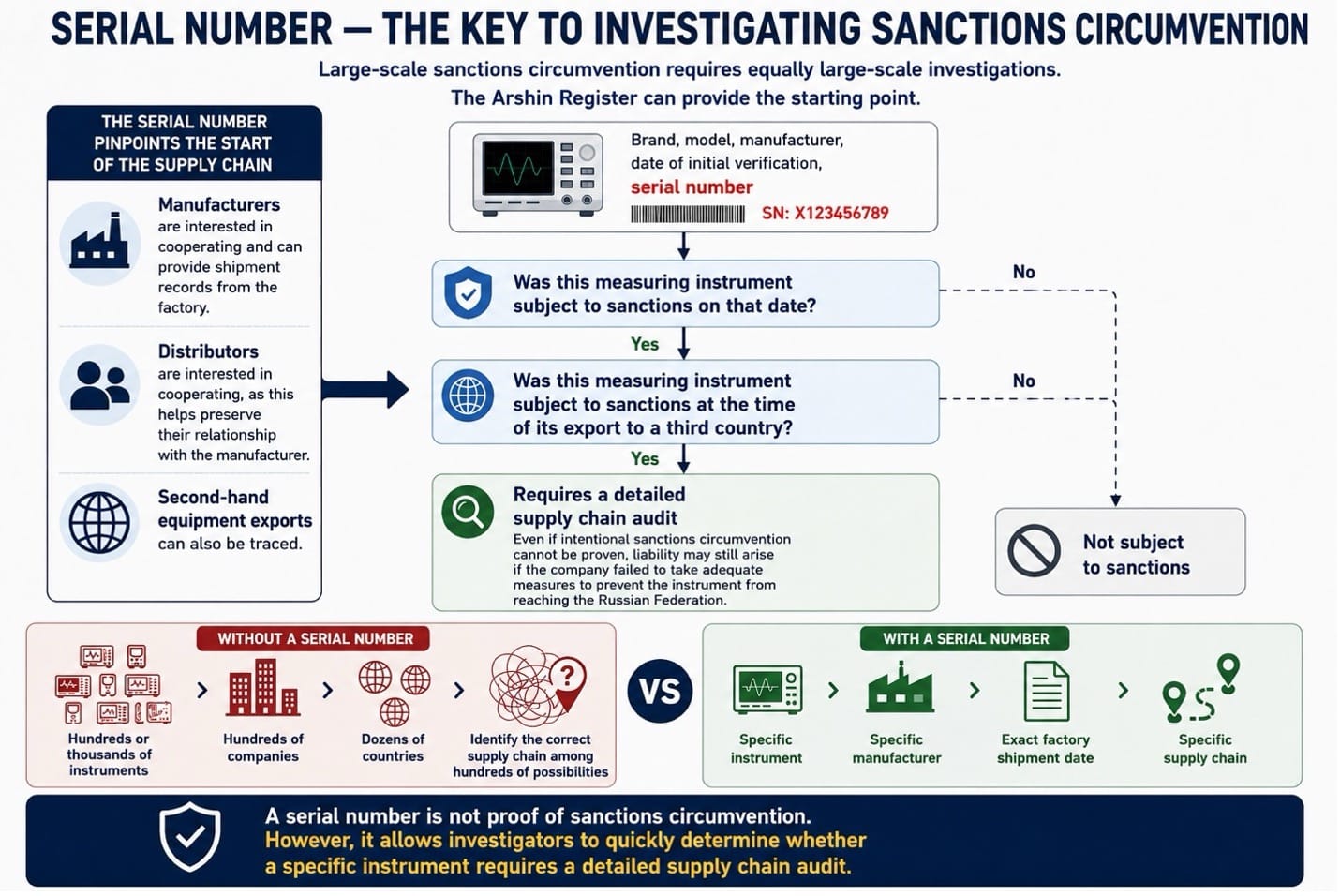
The availability of a serial number does more than just launch a manufacturer-led investigation. It eliminates the need to analyze hundreds of shipments of a given model, scrutinize specific time windows, or audit all documentation between specific counterparties, as the exact date and recipient of the shipment are immediately laid bare. The 'white' segment of the supply chain — manufacturers and authorized distributors — are vested party in the investigation; consequently, they will offer maximum cooperation to pinpoint exactly how the equipment migrated from the 'white' to the 'gray' and, ultimately, into the 'black' zone. It is precisely at this juncture that a potential violation of sanctions law begins. Furthermore, to prove that an instrument has entered the Russian Federation, it is no longer strictly necessary to untangle the rest of the supply chain, which may involve shell companies, falsified customs declarations, and classified contracts. This is entirely redundant because an official record already confirms that the instrument ultimately ended up in Russia. However, a serial number in the Arshin registry is not, on its own, definitive proof of sanctions evasion; rather, it provides a trigger for an audit. Accordingly, a database of these serial numbers serves as a tool for the mass auditing of systemic, large-scale sanctions evasion.
It should be noted that the Arshin registry provides a mechanism to conceal serial numbers for MIs imported via so-called “Parallel import” schemes by replacing the original serial number with an internal inventory number. Although such recommendations are actively circulated among verifiers and end-users, our targeted analysis indicates that such instances remain isolated, and the identification of the vast majority of MIs remains entirely feasible.
The arshin-west.com Website: A Tool for Right Queries
Searching the original FGIS 'Arshin' verification database does not allow for a distinction between initial and periodic verifications. The relatively small volume of initial verifications gets lost in a massive ocean of periodic records, turning the search process into an endless manual review of each certificate's individual page. Furthermore, the inability to search and group instruments by owner on the official platform goes without saying. These structural limitations likely explain why the 'Arshin' registry was previously overlooked as a viable data source for tracking Western equipment.
To bridge this gap and streamline accessibility, the arshin-west.com website was established. Currently, the platform hosts exclusively initial verification records for Western MIs. A high-speed, simultaneous multi-field search capability enables users to locate critical information instantly. Search results yield all necessary data at a glance – including the MI owner (where disclosed) – while direct links guide users to the official state certificate pages. Upon request from vested parties (such as manufacturers, compliance auditors, or investigators), we can provide more detailed datasets in spreadsheet formats.
Sanctions Imposed, Tariffs Received?
The data and specific examples provided above demonstrate a clear decline in volumes. This is how the effectiveness of sanctions is conventionally measured, and fundamentally, this is exactly how export-restrictive sanctions are supposed to work. However, is it correct to apply the same metric to sanctions that ban supplies to such a country? A ban on supplies implies a complete absence of supplies. A mere reduction in supplies resembles the effect of tariffs instead: they impact the trade balance, increase production costs, diminish investments, and lower the population's quality of life, among other things. Yet, tariffs do not impact the military sector—it remains largely price-inelastic, because when it comes to warfare production, having the equipment is all that matters.
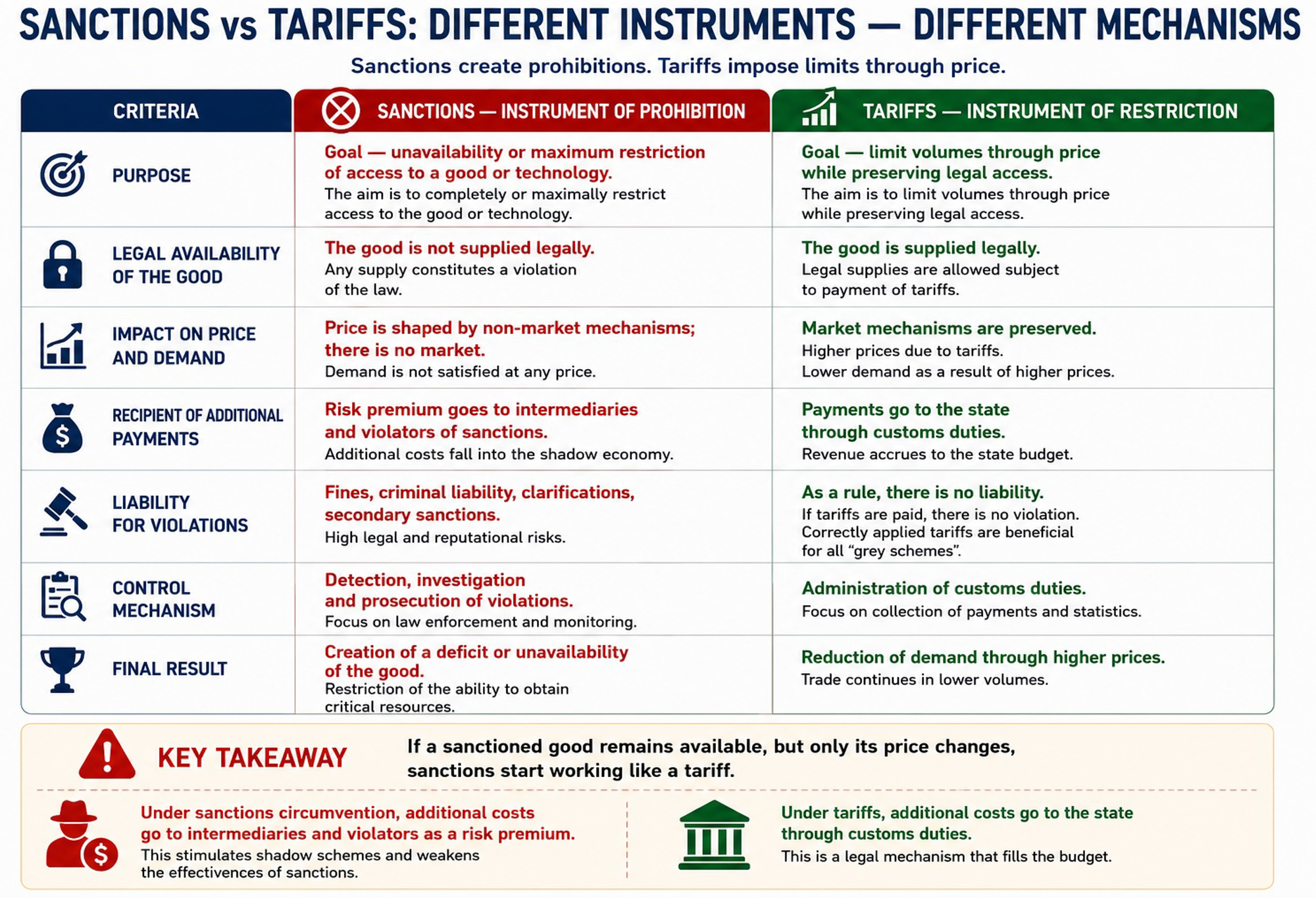
The objective of sanctions is total prohibition, not mere restriction. In other words, when sanctions actually work, a country must experience a severe DEFICIT of mass-market goods and technologies, while access to unique, cutting-edge solutions must be so tightly sealed that even intelligence agencies cannot consistently acquire them.
Currently, sanctioned goods remain readily available in Russia – a reality confirmed by basic online searches, numerous journalistic investigations, and materials from relevant trade exhibitions. When goods flow steadily through intermediaries, creating a functioning market within the sanctioned nation, the sanctions degrade into tariffs: if an instrument can be ordered, waited for, and successfully received, it is no longer an embargo, but a markup. The only difference from a legitimate tariff is that this 'duty' is collected not by the state, but by sanctions violators as a risk premium. For a civilian buyer, this markup acts as a deterrent (hence the observed decline in volumes); for the defense sector, however, price is secondary – any instrument required for drones, missiles, or nuclear programs will be purchased even at triple the cost.
Consequently, the focus must shift from merely drafting a new package of prohibitions to making enforcement mechanisms significantly more effective. The first direction involves expanding export control lists and frameworks – not just for dual-use goods, but also for foundational technologies accessible exclusively to Western nations. The second direction requires regular post-sale monitoring of the end-user: an end-user declaration is verified only once, at the time of issuance, while post-shipment on-site audits cover a mere 6% of licenses issued to high-risk countries (GAO Report, 2004; the situation in the EU is no better — CDT Europe, 2025). In contrast, sophisticated equipment relies on a continuous relationship with the manufacturer for updates, technical maintenance, and spare parts; this represents a fully functional yet largely untapped control point. The potential of leveraging this mechanism was clearly demonstrated in February 2026: thousands of Starlink terminals procured by the Russian military via illicit gray-market networks were instantly neutralized by a single SpaceX decision to deactivate unverified devices. While an electron microscope cannot be 'shut down' in the same manner, the underlying principle remains identical: dependency on the manufacturer exists for any advanced instrument.
The third – and potentially most effective – direction is to make the serial number visible to the state. Today, an export-import declaration contains a product description, commodity code, quantity, and value, but lacks the serial number of the specific item. As a result, the state only sees that a 'mass spectrometer' was exported, but cannot verify if this is the exact same unit that ended up at a Russian defense plant a few years later. If a serial number becomes a mandatory field in declarations for designated product categories — not only in the manufacturing country but during every subsequent export-import operation across partner nations—the instrument will acquire a continuous digital footprint: 'factory → export → import → resale → user,' with the exact same number stamped at every single step. Identifying a device in Russia would then cease to be an investigation from scratch; instead, it would become a straightforward audit of an existing chain of records. A vehicle possesses a VIN that remains traceable for decades; a mass spectrometer worth hundreds of thousands of dollars typically does not, despite already having a serial number. The final step is simply to integrate it into international documentation—essentially building a traceability system for critical equipment.
All three directions point to the same conclusion. While another sanctions package addresses the question of 'what else should be banned?', the solutions outlined above answer a different, equally critical question: 'are the existing bans being enforced?'. Because sanctions only work when violations can be detected.
How Accurate Are Our Data?
First, a clear distinction must be made between data extraction errors and data interpretation errors. For instance, the statement 'the registry contains X number of initial verification records' is an empirical fact. However, concluding that 'X number of initial verifications were actually performed' is incorrect, as the registry contains duplicate verification records, redundant serial numbers, and similar data noise. Furthermore, even if we know with absolute certainty that 'Y number of initial verifications were performed,' this does not automatically mean that Y number of instruments were commissioned; until 2025, initial verifications were also legally triggered following major overhauls or capital repairs. These specific discrepancies tend to overstate the actual state of affairs.
Similarly, an initial verification date after May 1, 2022, does not definitively prove that the instrument was imported after the outbreak of the war. Conversely, a measuring instrument could have been imported and verified in April 2022, thereby falling entirely outside our statistical tracking window. It is also vital to remember that the registry is subject to manual data entry, introducing a significant volume of clerical errors that can alter equipment classification, country of origin, or technological sophistication levels. The semi-automated classification of over 9,000+ equipment types represents an analytical compromise, and there is undoubtedly room for refinement. These margin-of-error factors cut both ways.
On the other hand, the following factors systematically understate the actual volume of equipment: verification is legally mandatory only within strictly regulated domains, and the most sensitive hardware utilized in classified, top-secret programs may never appear in the public registry at all.
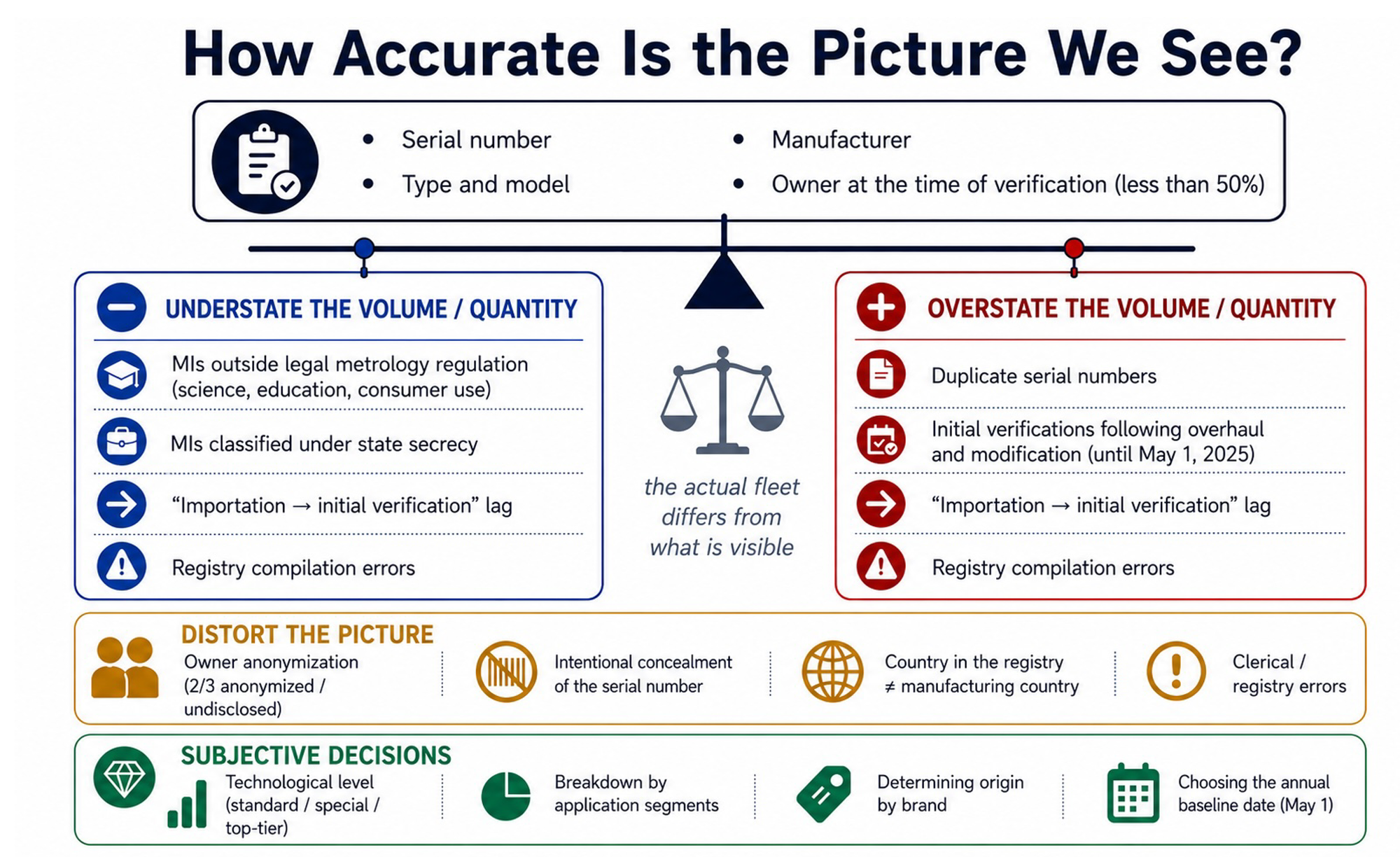
While all the aforementioned factors influence the overall picture, they do not significantly distort it. The primary value of this study lies not in delivering precise, exact figures but in demonstrating that an open metrological registry can effectively serve as a tool for analyzing industrial and technological dependence. Whether exactly 27,000, 25,000, or even 20,000 units of irreplaceable equipment entered the Russian Federation during the war years is secondary to the scope of this research. What truly matters is the undeniable fact that large-scale, industrial-grade access to Western equipment has been sustained.
Instead of a Conclusion
These instruments were never engineered for warfare: an electron microscope was built to see viruses, a mass spectrometer to discover medicines, and a helium leak detector to construct MRI scanners. Yet, that very same microscope is vital for a microelectronics manufacturer, the same mass spectrometer for a chemical weapons specialist, and the same leak detector for a rocket engine developer. This fundamental duality is precisely why the international community originally established export control regimes. However, it appears that these frameworks function effectively only when dealing with honest actors – or rather, they have become far easier to circumvent in an interconnected, globalized economy.
These instruments were never engineered for warfare: an electron microscope was built to see viruses, a mass spectrometer to discover medicines, and a helium leak detector to construct MRI scanners. Yet, that very same microscope is vital for a microelectronics manufacturer, the same mass spectrometer for a chemical weapons specialist, and the same leak detector for a rocket engine developer. This fundamental duality is precisely why the international community originally established export control regimes. However, it appears that these frameworks function effectively only when dealing with honest actors—or rather, they have become far easier to circumvent in an interconnected, globalized economy.


Обговорення –